
SERVICES & SUPPORT WE OFFER
Navigating the challenges and complexities life brings with support, trust, compassion and innovation.
Life can often be intricate and change can bring its share of worries. At Strongest Starts, we pride ourselves on our determination to ensure that we help young people with simplifying the daily challenges of living.
We ensure this by creating a safe, secure and homely environment, equipped with the necessary tools to encourage, support and uplift young people. This is paramount to ensure their success when they move onto independent living.
Young People’s Supported Living
When a young person first joins us, we undertake an initial assessment as to ensure that we customise their support plan and subsequently ensure the development of their stability and independent living skills, as well as reducing any risky behaviour and identifying any concerns that may have been missed, at an early stage.
Young people are provided with private, fully furnished, lockable bedrooms, welcome baskets containing essentials and some treats, and share the other facilities within the home including the kitchen, bathroom, and living area.
Our robust support services include an immediate allocation of a dedicated key worker upon arrival, who will be the point of call for the young person throughout their stay. The key worker's role is to provide consistent one-to-one support, guidance, and mentoring to help young individuals with personal affairs, independent life skills, budgeting, and personal development. We also maintain a monthly progress report to monitor each individual's journey.
Unaccompanied minors
Strongest Starts also opens our doors to children/young people who have to seek asylum in the UK without parental supervision. When unaccompanied minors, referred to formally as Unaccompanied Asylum-Seeking Children (UASC), first join Strongest Starts, we conduct an initial assessment which includes a “tailored support plan” and a comprehensive "Journey to the UK Assessment." This assessment is a crucial step in better understanding the unique support needs of each young person and identifying any traumas they may have experienced during their journey to the UK.
Through completing this specialised assessment, staff are able to gain deeper understanding into the child's background, journey and any immediate concerns or risks. This subsequently ensures that the correct support is put in place at an early stage, as well as any relevant risk assessments to ensure further safety. In addition to this, this process also allows us to identify and address any emotional or psychological trauma that may have occurred during their travel to the UK. These steps help with supporting our goal to safeguard and nurture children whom we don't have as much information on. The overall aim is to encourage their healing and integration into the community. Our links with organisations such as the Refugee Council and specialist counselling services for young people, further supports with this.
SUPPORT WE OFFER:
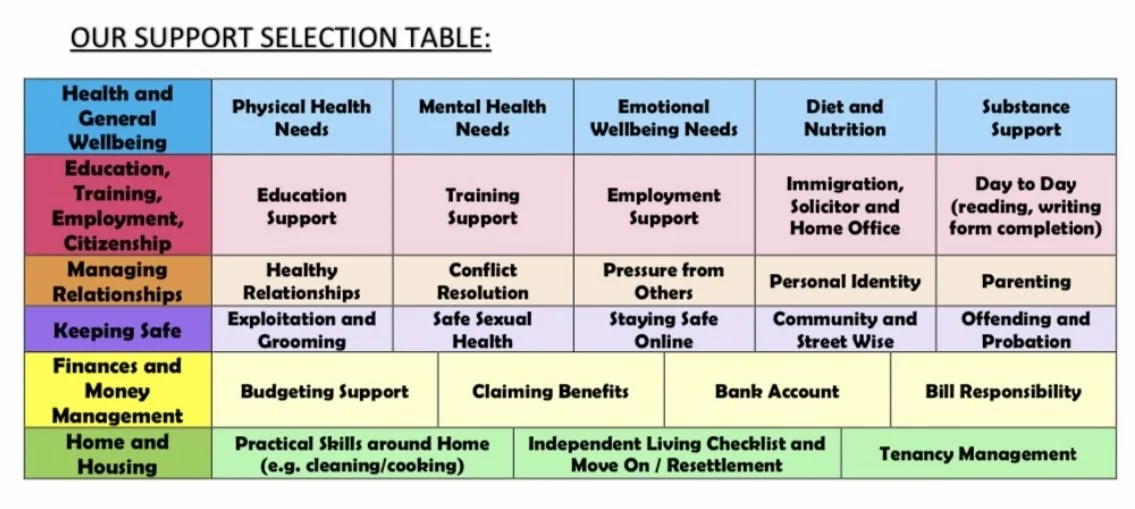
Some of the main services that Strongest Starts offer alongside accommodation includes:
• Providing emotional support - for example, by building a relationship and providing a safe and open space to talk about any personal challenges or issues, ensuring consistent welfare check ins and providing support with key relationships.
• Providing practical support - such as helping with household tasks, booking appointments for example at the job centre/benefit agencies and helping with paperwork and application forms.
• Supporting young people's education, training & employment (ETE) needs - encouraging individual progress through attending relevant meetings, providing support with applications and sourcing initial ETE opportunities.
• Supporting and monitoring young people’s healthcare needs - both physical and emotional, also through attending relevant appointments with them.
• Religion and cultural support - including support with attending places of worship and finding relevant religious items.
• Safeguarding support - reporting of any observations relating to our young people’s wellbeing, welfare or safety.
• Attending meetings with young people - for example, LAC reviews, education meetings & solicitor appointments.
• Supporting young people to pursue personal hobbies and interests - such as sports, pottery, singing or drama, all of which will be identified within the local community.
• Teaching and encouraging life skills - such as budgeting and paying bills.
• Supporting young people with their independent living skill checklists - to ensure their stability when moving into the community independently and living alone.
• Encouraging everyday tasks - such as meal preparation, writing a shopping list and going shopping, cleaning and maintaining areas within the home.
• Providing support with accessing community facilities - supporting confidence with this and around integration into community groups.
• Understanding the communication needs of young people - and adapting communication to suit each individual, e.g. language, tone, body language.
• Supporting work and relationships with other professionals - such as social workers and college staff to ensure consistency of support and strong multi-agency working.
• Counselling and confidence building programmes/support - ensure that young people feel able to be their best selves and conquer life's challenges.
• Exploitation awareness and intervention - to ensure young people's safety in the community/new environments (for those newly arriving in the UK).
• Composing and sending progress reports to young people’s social worker/personal advisor - these reports will always be available to and shared with young people during key work sessions.
• Support with asylum applications and other legal matters - we understand the importance of supporting with Home Office appointments and the legal processes and procedures.
• Support with reducing risky behaviour that could lead to exploitation - such as gang education, awareness and interventions when necessary.
• Support with managing neurodiversity - including; ADHD, autism, and other behavioural or developmental diagnoses.
• Safety assurance through monitoring and oversight - completing room checks several times a week and monitoring CCTV systems as to ensure resident safety and security.
Services
Filters
No results found
No results match your search. Try removing a few filters.
Contact us
Interested in making a referral? Please share some basic information on the young person, and we will be in touch shortly. We look forward to hearing from you.